

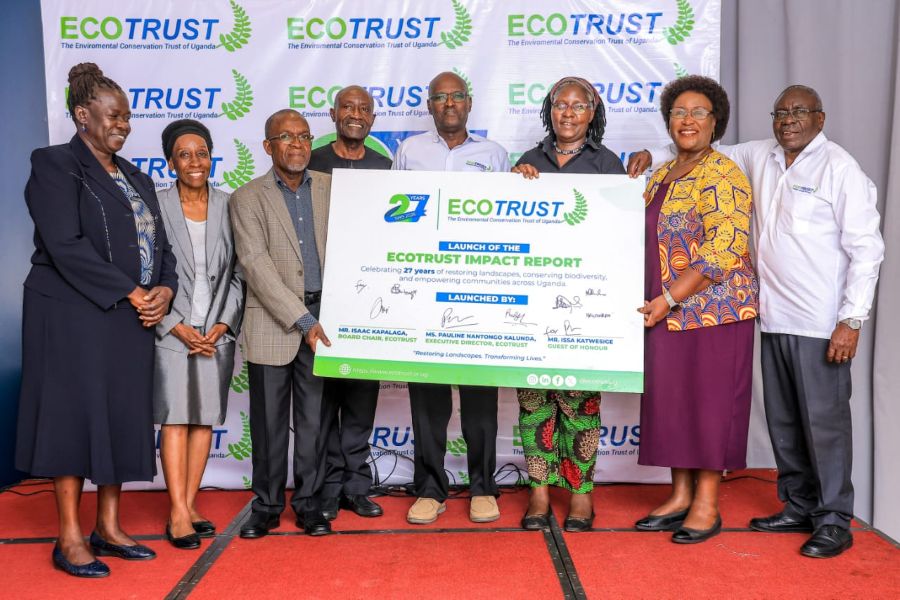
Environmental Conservation Trust of Uganda (ECOTRUST) has launched activities to mark 27 years of promoting conservation financing, biodiversity restoration, and sustainable livelihoods in Uganda.
Speaking during a media engagement at Golden Tulip Canaan Kampala, ECOTRUST Executive Director Pauline Nantongo Kalunda said the anniversary celebrations will highlight nearly three decades of the organization’s contribution to environmental conservation and support for rural smallholder communities across the country.
“Twenty-seven years is a significant milestone for any institution, especially in a sector where many organizations struggle to survive beyond their early years,” Nantongo said.
“Our work has always focused on ensuring that conservation is not only environmentally important, but also economically meaningful for local communities,” she added.
Founded in 1999 following the transformation of a former environmental grants management unit supported by the United States Agency for International Development (USAID), ECOTRUST was established with the mission of conserving biological diversity while improving social welfare through sustainable environmental management.
Nantongo said one of the organization’s flagship initiatives is the “Trees for Global Benefits” programme, launched in 2003 and regarded as one of Africa’s earliest cooperative carbon offset schemes.
The programme connects Ugandan smallholder farmers to voluntary carbon markets while promoting sustainable land restoration and improved livelihoods.
According to Nantongo, ECOTRUST’s model focuses on making conservation economically beneficial for farmers and local communities.
“We want farmers to grow trees because it makes economic sense for them, not simply because they are saving the environment,” she said.
“When environmental services such as carbon storage, watershed protection, and climate regulation are properly valued, conservation becomes a profitable and sustainable land-use option,” she added.
Through its landscape restoration model, ECOTRUST supports farmers to establish enterprises in timber production, coffee growing, cocoa farming, fruit cultivation, medicinal extracts, honey production, fish farming, and fuel wood production. The organization also helps communities access financing through carbon credits, biodiversity credits, and private conservation investments.
Nantongo noted that from its initial operations in the Queen Elizabeth landscape, ECOTRUST has expanded its activities to the Rwenzori Mountains, Mount Elgon, Murchison Falls, Northern Uganda, and the Mpologoma landscape.
“Today, ECOTRUST works with more than 54,000 households and supports the restoration and management of over 70,000 hectares of land across five major landscapes,” she said.
She added that the organization has significantly reduced its reliance on traditional donor funding, with about 80 percent of its financing now coming from private philanthropy, conservation service agreements, and its endowment fund, while only 20 percent comes from public donor support.
ECOTRUST Board Chairperson Isaac Kapalaga praised the organization’s growth and contribution to expanding conservation efforts across Uganda since its establishment in 1999.
